Projector rental in Singapore: what to ask for
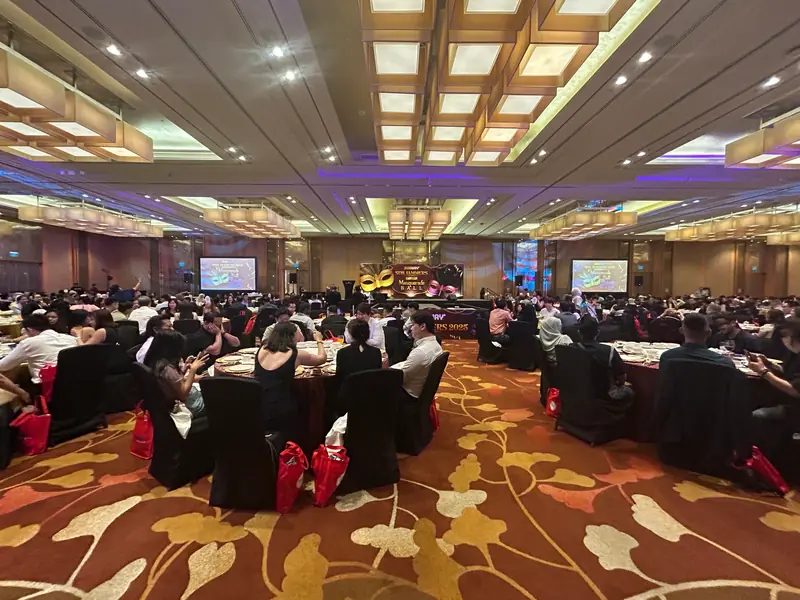
Most projector enquiries that reach us open with a number. Someone has been told they need eight thousand lumens, or twelve, and wants a price against it. It is a fair place to start and it is the least useful number in the conversation, because on its own it says nothing about whether the back row will be able to read a slide.
A projector is specified by brightness against ambient light and throw distance, not by lumens alone. Three things set those, and the lumens figure falls out of them at the end rather than going in at the start.
Ambient light decides it before anything else
The picture has to compete with everything else the room is doing: house lights the venue will not fully dim, windows down one wall, stage wash on the speaker, and a screen on every table during a dinner.
A dim function room with controllable lighting does fine on fast-fold projection, at a fraction of the cost of the alternative. A bright ballroom, or a room with windows, needs an LED wall instead, because an LED wall makes its own light rather than borrowing what the room has left over. Past a certain amount of ambient light, more lumens stops buying a better picture and starts buying a more expensive one.
So the first question is not how many lumens. It is whether the room can be darkened, and how far the venue will actually go on the day.
Throw distance, and whether the projector goes in front or behind
Throw distance sets the lens before it sets the projector. A wide, shallow ballroom needs a short throw or the projector ends up in the middle of the seating. A long room lets it sit further back on a standard lens, which is cheaper and easier to focus.
Rear projection hides the throw and keeps presenters out of their own shadow, which is worth paying for at anything where people walk the stage. It costs room depth behind the screen, and that depth is usually space the seating plan has already spent, so it is a decision to make while the layout is still moving.
The screen is half the hire
Screen size follows the furthest seat, not the stage. A screen that looks generous from the lectern can be unreadable from the back tables, and that is the failure people remember. Fast-fold screens come in front or rear configurations and are sized against throw distance and ambient light together, which is why a projector screen rental quoted without the room is guesswork.
Fast-folds travel and build on site, so a venue with no installed screen is not a problem. What matters is the sightline: check the screen height against the distance to the back row, and check that nothing in the room, a chandelier or a structural column, sits in the way of half the audience.
What comes with the picture
The projector is rarely the whole job. A conference or a dinner usually needs switching between sources, confidence monitors so speakers read their slides without turning around, a countdown clock, and holding slides between segments.
Content gets its own pass: a deck check the day before, aspect ratio corrected, and embedded video tested with its audio. That check is where most of the problems are found, and it is far easier to fix a 4:3 deck on a Tuesday than in the ten minutes before doors.
On crew, anything with live speech needs a technician for the whole event. A playback-only setup in a small meeting room can be handed over after a briefing, but as soon as someone is speaking into a microphone, somebody has to be on the desk.
What moves the price
For projection specifically, the price moves on screen size, projector brightness, and whether the room can be darkened. Widen that to a full quote and it also moves on the number of open microphones, screen area and type, crew hours including load-in and strike, and whether the venue's house system can carry part of the job.
Which is why a projector rental cost given over the phone, before anyone has seen the room, is a guess. The equipment list sets out what sits behind each of those lines, including how an LED wall compares once ambient light rules projection out.
How early to book
Two to four weeks is comfortable for a standard conference. Year-end dinners and the AGM season book out earlier than people expect, so a date in that window is worth holding as soon as the venue is confirmed. Short notice still works when the venue has a load-in window to give you, which is the real constraint rather than the kit.
What to send instead of a lumens number
The venue and room name, the seating layout, where the furthest seat is, whether the house lights can be dimmed, and what is going on screen. That is enough to specify the projector, the lens and the screen as one thing, and to say plainly when projection is the wrong tool for the room and an LED wall is not.
Send the venue, the date and the seating layout, and we will come back with the projector, the lens and the screen specified together, line by line.