Truss rental in Singapore: what it holds up
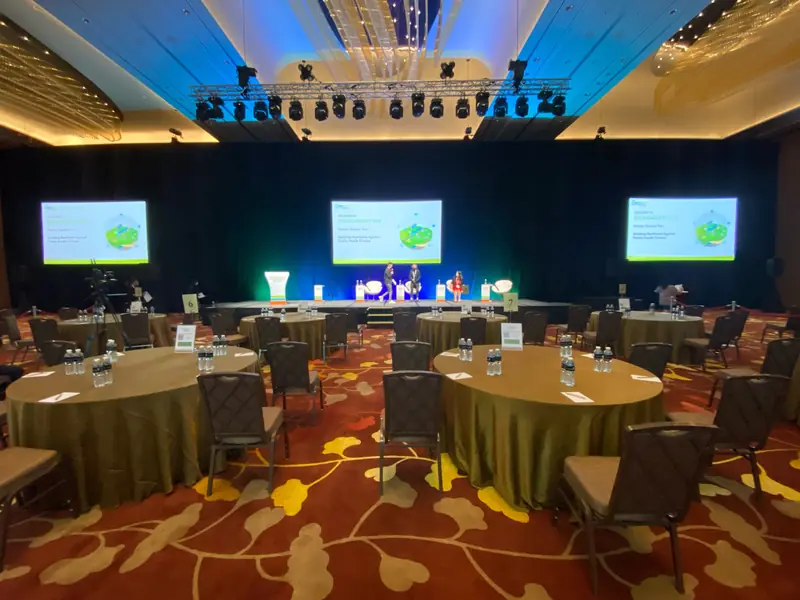
Truss is usually the last line on a quote and the first thing that decides whether the rest of the design is possible. Lights have to hang somewhere. So does a screen, often enough. By the time anyone asks about truss, the lighting plan and the screen size are normally fixed, and the honest answer is sometimes that the room will not take them.
It is worth asking early, because it is a venue question as much as a kit question.
Rigged from the ceiling, or standing on the floor
There are two ways truss gets into a room. Rigged means hung from points in the ceiling. Ground supported means towers at each end carrying a horizontal span, which is the goalpost shape you see over most hotel stages.
Most Singapore ballrooms settle this for you. Rigging points are limited, several venues require their own rigger, and some rooms do not allow anything hung at all. Ground support works anywhere with the floor and the headroom for it, and it costs floor area at both ends. Towers and their bases take up space the seating plan has to give back.
Span decides the section
The longer the run, the heavier the truss has to be to carry the same load without sagging in the middle. A short span over a lectern is a different piece of kit from one crossing a ballroom stage.
Which is why the first question is how wide the stage is, not how many lights are going on it. Width sets the section and the section sets the weight, and that weight is the number a venue measures against its own rigging limit.
Height is a sightline question as well as a safety one
Trim height, meaning the height the truss sits at, gets set by three things at once: the throw the fixtures need, the sightline from the back of the room, and whatever the venue permits.
Too low and the front tables look at fixtures instead of the stage. Too high and the angle gets steep, which drops shadow into eye sockets and under chins. That reads far worse on camera than it looks in the room. Low ceilings are the awkward rooms, because the lighting and the screen are both competing for the same vertical space.
Load is the part nobody asks about
Truss carries more than lights. Screens, LED panels, speakers, backdrops and the cable for all of it. Each has a weight and the total is what decides the structure.
LED is the heavy one. A wall built in the air rather than stacked on the floor changes the rigging conversation completely, which is part of why the equipment list treats the screen decision and the lighting decision as separate specifications rather than one line item.
What moves the price
Section and length, how many towers, whether ballast is needed to weight them, the crew time to build and strike, and the venue's own rules about who is allowed to rig in their room. That last one is not a GMP cost and it is regularly the largest surprise on a hotel job.
Truss sits inside stage, rigging and power rather than being quoted on its own, because the structure and what hangs off it are one decision.
What to send us
A floor plan with the stage position on it, the ceiling height, and whatever the venue has said about rigging. That is usually enough to tell you whether the design hangs or stands before anyone prices it. For the stage under it, the stage rental guide covers the risers, steps and skirting.
Send the floor plan and the venue rigging rules and we will tell you whether the design works in that room before it goes any further.