Town hall meeting AV: Q&A and remote staff
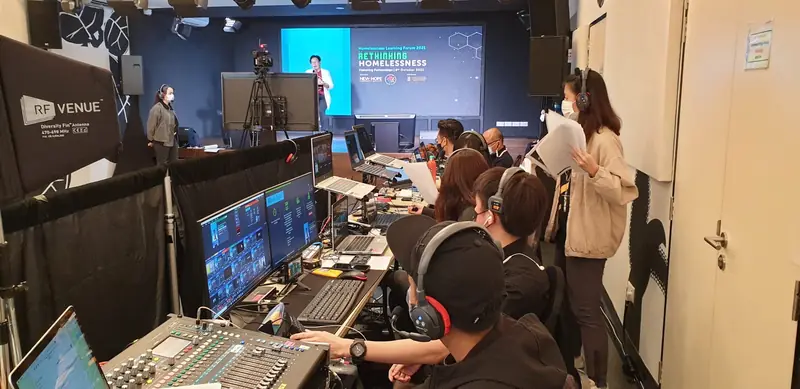
A company town hall is three things at once: leadership talking to everyone, everyone allowed to ask questions, and part of the company watching from another office or another country. Most of the AV decisions come from the second and the third.
The room
Leadership on a stage or at the front, slides behind them, staff seated theatre style. The usual rules apply: screens sized for the back row, speakers covering the whole room, and the stage lit so faces read on camera. The seating layout guide covers how the layout moves the rest.
Questions are the part that breaks
A question asked from the floor without a microphone is heard by the people sitting nearby and by nobody watching remotely. So the question and answer needs a plan: roving handheld microphones with someone carrying them, or standing microphones in the aisles that people walk up to. Roving is quicker for the room. Standing microphones need less crew, and a queue at a microphone keeps the order clear.
The other half of the plan is the questions that arrive in writing, from remote staff or from people who would rather not stand up. Many companies collect them through a question app. A moderator reads each one out on a microphone, so the room and the stream both hear the question before the answer.
Remote staff get the desk feed
The stream should carry sound from the mixing desk, not from a camera microphone at the back, and the slides as a clean feed rather than a camera pointed at the screen. The live streaming guide covers that side in detail.
If another office is going to speak rather than just watch, that is a two-way link: their picture on the room's screens and their sound in the room's speakers. It needs testing with the people at the other end before doors, at the levels they will use on the day.
Keep it internal
Town halls carry information a company does not want outside the building. The stream goes to the company's own platform or a private link, and whether it is recorded, and who keeps the recording, is worth agreeing in writing before the day.
Office or ballroom
Plenty of town halls happen in the office: a cafeteria or an open floor that was never designed for an audience. That usually means bringing everything in, sound included, and working around ceilings with no rigging points and power that was planned for desks. A hotel ballroom has more of what an event needs and less flexibility on timing. Both work, and they are different jobs.
What moves the price
The number of cameras, whether the event is streamed and recorded, how many microphones the questions need, any two-way links to other offices, and whether the venue has a usable house system. Hybrid and livestream covers the camera side, and the microphones are on the equipment list.
What to send us
The venue, how many people are in the room and how many are watching remotely, how questions will be taken, whether any other office presents, and whether a recording is needed afterwards.
Tell us how the questions will run and who is watching from where, and we will quote the room and the stream as one job.